A million Gaussian splats on WebGPU, now in the headset
The WebGPU Splats template draws splats with Radix, which sorts every splat on the graphics card each frame. Since 0.20.1 a headset browser that offers WebGPU for immersive sessions draws both eyes on WebGPU too.
Graspable 4 min read
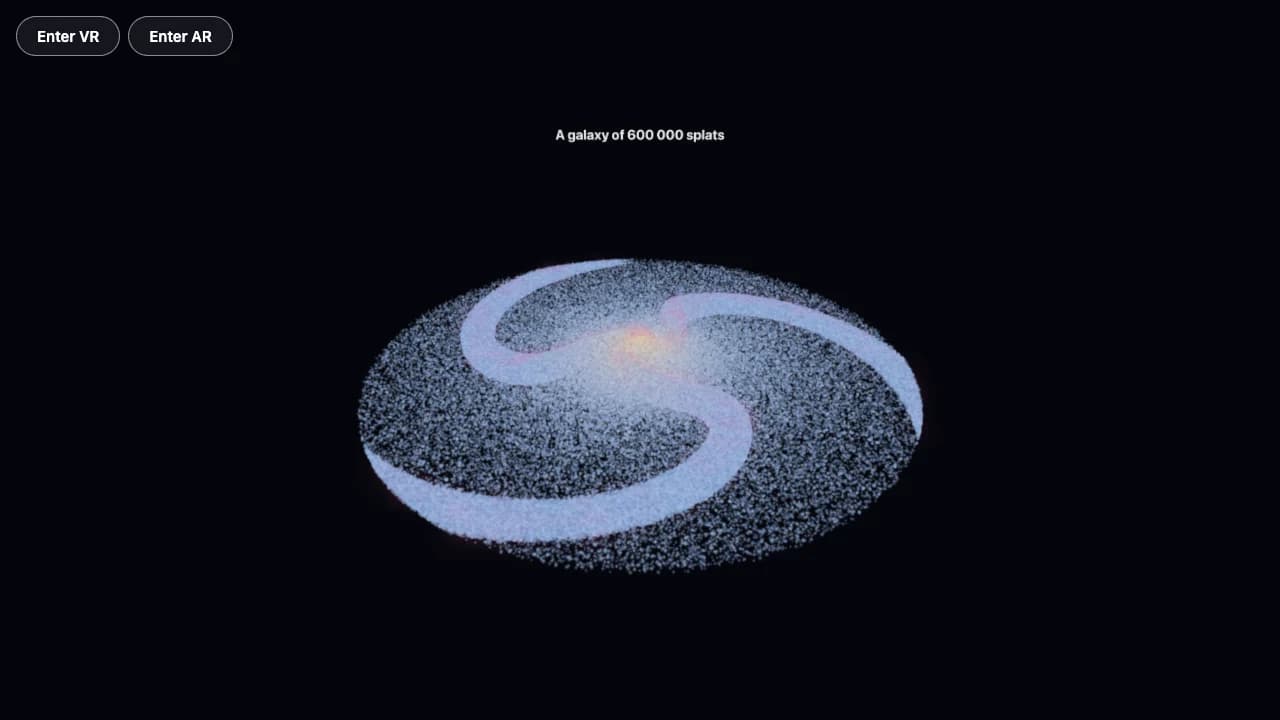
A new Graspable project from the WebGPU Splats template opens on a spiral galaxy of 600 000 Gaussian splats, made by code that runs on the graphics card. The renderer behind it is Radix, the WebGPU splat renderer from the team that makes Spark. Since Graspable 0.20.1, the same scene also draws on WebGPU inside a headset whose browser offers it.
Sorting on the graphics card
Gaussian splats are see-through, so they have to be drawn back to front, and the order changes whenever the viewer moves. Sorting is the expensive part. Spark, which draws our world templates, sorts on the processor in a worker and sends the order to the graphics card.
On WebGPU, Radix keeps the whole frame on the graphics card. A projection pass places every splat relative to the viewer and writes a sort key. Splats outside the view are dropped, a radix sort orders the rest, and one draw call puts every splat of every object on screen. Radix's own explanation says nothing is read back to the processor.
Radix's authors measured it against Spark across five scenes of 0.5 to 10 million splats. On WebGPU, Radix was 1.37 times as fast as Spark on WebGL2 on average, and 1.8 times as fast at 10 million. On WebGL2, Spark was slightly faster. Those are their numbers, on their hardware.
Ours, on an Apple M1 Max in Chrome at 1600 × 1000, with frames paced by the graphics card:
- 500 000 splats: 4.9 ms a frame
- 1 000 000 splats: 10 to 12 ms
- 2 000 000 splats: 17.6 ms
Above about three million the frame times start to jump around, so that is the practical ceiling on that computer. A recent computer shows one to two million splats smoothly.
Splats made by code
In Radix a generator is a small shader that makes splat number i while the frame is drawn. A splat file is one generator; the galaxy is another. Changing a value such as the galaxy's rotation compiles nothing, so a scene can animate millions of splats every frame.
Julia, 128 BPM shows how far that goes. It is a quaternion Julia fractal made of a million splats on WebGPU. The graphics card traces the shape into a table, traces a slice of it again each frame as the music changes it, and lights every sample every frame. The project was rebuilt on Radix in Graspable and is published in Made in Graspable.
The template also reads captured places: .spz and .ply files, including compressed .ply, drawn in the same sort as the splats made by code.
Both eyes on WebGPU
A headset session needs the browser to hand the page a WebGPU surface for each eye. That is the WebXR/WebGPU Binding, still an editor's draft. Meta Browser 146 added experimental support for WebGPU in WebXR, and three.js 0.186, which the template uses, can render each eye into it.
In 0.20.1 the template asks for a WebGPU session wherever the browser offers one. Radix then projects and sorts once per frame from the head, and only the draw is done twice, once per eye. A browser without the binding gets Radix's WebGL2 path, where the projection runs on the graphics card and the sort runs in a worker. The choice is made once, before the first frame, because a canvas cannot change its type later.
To use it on a Quest, run Meta Browser 146 or later, turn on its WebGPU and WebXR experiments in chrome://flags, and restart the browser.
The difference should be largest on the headset. On the WebGL2 path the headset's processor does the sort, and it is much slower than a desktop's. On WebGPU it does not take part. Open Julia, 128 BPM in the headset: under the fractal it shows the path in use, the splat count, the frame rate and the frame time. Add ?gpu=webgpu or ?gpu=webgpu-gl to the address to compare the two paths, and ?count= to change the number of splats.
Starting a project
Create a project from WebGPU Splats in Graspable and describe what you want: replace the galaxy with your own shape, load a captured room from public/splats/, or mix both with ordinary three.js meshes. The template comes with a guide the agent reads before it writes splat code. The preview shows the scene on your screen and in the emulated headset, and a published app opens in a headset browser at its own address.
Radix is new (version 0.0.1). It does not yet read .splat, .ksplat or .sog files, has no level-of-detail streaming and cannot pick a splat with a pointer. For large captured worlds with streaming, the world templates on Spark are still the right choice.
Sources
- Radix and why Radix, with its benchmark against Spark
- WebXR/WebGPU Binding Module, editor's draft
- Meta Browser 146 release notes
- Graspable changelog: 0.20.1